
July CRU: Are You Investing for Headlines or the Long Term?
July 21, 2026
“Conversations with clients …” is an informal communication from one of our participating money managers, Jason Thomas, PhD, CFA, CEO of Portfolio Design Labs.
Some things are starting to feel a bit… repetitive. The stock market hits new highs driven by excitement over a new artificial intelligence (AI) model or announcement of yet another huge infrastructure investment, only to fall in fear of too much spending. Hopes that an effective resolution to the US-Iran conflict is within reach are dashed by renewed hostilities with no obvious end in sight.
Other aspects off the current environment are new-ish, at least in magnitude. Just this year, IBM has experienced its biggest one-day decline since 2000 (in February), its biggest one-day rally since 1968 (May), a new all-time record high (June) and, today, its biggest one-day plunge since 1968 (due to disappointing comments about its business this past quarter).
New investment products that provide the potential for outsized returns are partly to blame for the increased volatility of individual stocks. In the case of IBM, AI and other advanced technologies are also part of the story. IBM is one of the leaders in quantum computing, which may ultimately be worth trillions of dollars or nothing. Also, fears about AI caused IBM’s big customers to accelerate spending on cybersecurity, deprioritizing IBM’s products and services.
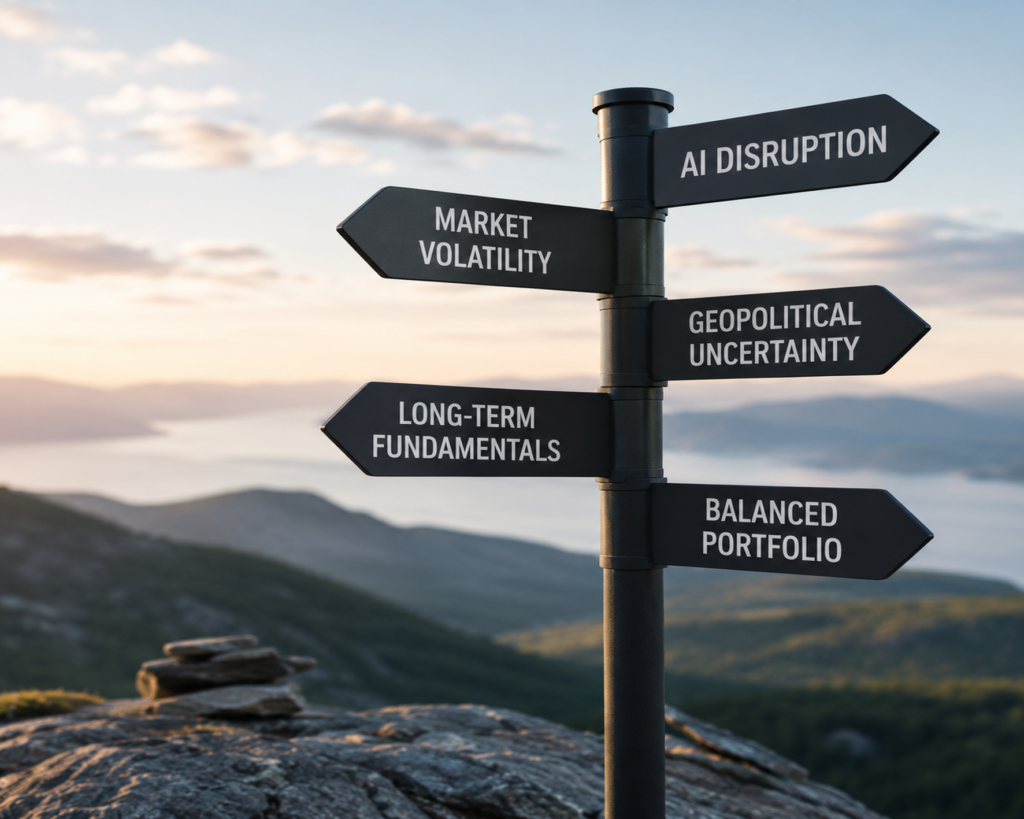
With personal experience in the Dot Com boom/bust and the Great Financial Crisis, many investors have enough personal experience to appreciate the benefits of a balanced approach. But how to achieve that in a world where the costs and benefits of AI seem to be woven through every part of the economy?
Always handy with acronyms, Goldman Sachs highlights companies with valuable physical assets, infrastructure and industrial capacity that are least likely to be undermined by AI — Heavy Assets, Low Obsolescence (HALO). Added to a portfolio of companies expected to benefit from AI disruption, HALO companies can provide important ballast against changing market sentiment.
We agree and think of HALO as one outcome of a broader investment philosophy focusing on fundamentals. By looking past simplistic categories like sectors and styles into the fundamental characteristics of a business, investors can build portfolios that may participate across the wide range of technological and geopolitical outcomes.
Disclaimer: The information provided is for educational purposes only and is not intended as investment advice. Past performance does not guarantee future results. Investors should consult with a qualified financial professional before making any investment decisions.